
Ice Trials Continue as ABS Advances Field‑Tested Capability
Advancing ice navigation technology requires collaboration in real-world operating environments. In February, ABS supported field testing for Canada’s ICENAV research program, which studies ice conditions and helps develop technology to enable safer navigation in polar waters. Through this program, ABS is working with industry leaders to help improve ice-class vessel design and operations.
Among those partners is Canada’s National Research Council (NRC), whose research compliments in important technical areas. While program objectives differ, both efforts rely on accurate detection and classification of ice. This alignment supports shared learning and more efficient development across programs.
Supporting On‑Ice Operations
ICESIGHTS is an ABS-led research and technology initiative focused on improving ice detection, characterization and decision-making for vessels operating in ice-covered waters. ABS continued this initiative aboard the Royal Canadian Navy vessel HMCS FRÉDÉRICK ROLETTE during a 21-day deployment conducted under active ice conditions. While this voyage differed from earlier ICESIGHTS deployments, each trial contributes to a growing foundation of field validated learning that informs system development and operational readiness.
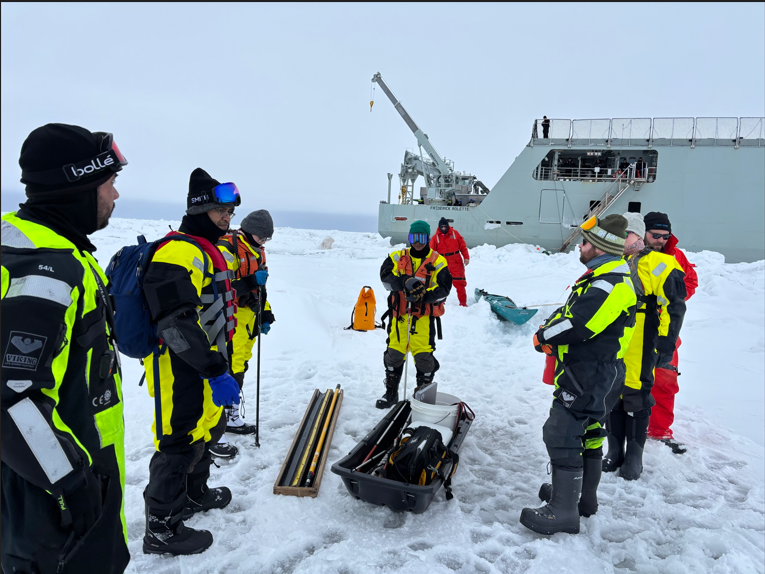
During the trials, ABS worked alongside a multidisciplinary science team in dynamic ice environments. Ice and weather conditions required frequent movement between sampling locations, with on‑ice activities adjusted continuously as conditions evolved. Operations included coordinating the safe deployment and recovery of sampling equipment between the vessel and the ice, maintaining controlled work areas during hoisting operations and supporting efficient transitions between sample sites.
On-ice teams quickly collected and characterized ice cores, then processed them with specialized equipment to measure ice thickness and generate temperature profiles. They took temperature readings at defined intervals along each core and logged the data in real time to preserve accuracy and maintain data integrity under field conditions.
Following on-ice operations, the team analyzed samples on board to further document ice properties. This work included segmenting ice cores by depth, measuring physical dimensions to calculate density and conducting salinity analysis after controlled melting. ABS maintained digital records throughout the process to enable traceability and support post-trial analysis.


Caption: (Top) ABS Engineer Michael Grant assessing the ICESIGHTS system, (Bottom) From the ice as the Science Team prepares for ice coring
Integrated ABS Engagement
The deployment also highlighted the value of the integrated role ABS plays across research, survey and classification activities. The HMCS FRÉDÉRICK ROLETTE is currently sailing with an ABS class certificate, reflecting an established relationship between ABS and the Canadian Navy. That relationship supported close coordination during system installation and testing, including contributions from an ABS surveyor conducting routine survey activities prior to the voyage.
This integrated approach demonstrates the full-service relationship in action, supporting applied research so that insights gained through ICESIGHTS are informed by operational experience and aligned with classification and survey practices.
Guidance Built through Experience
ABS continues to strengthen its practical understanding of ice operations through firsthand experience conducting ice trails across different regions and operating contexts. Each deployment adds to the knowledge base supporting ICESIGHTS and reinforces the commitment of ABS to advancing safety, reliability and performance for vessels operating in ice-covered seas waters. As ICESIGHTS development continues, field-validated insight remains central because safer polar navigation begins long before a vessel encounters ice.
